

It’s Monday morning. Your cleaning contractor sends someone new because the usual person is off sick. They seem capable, they get on with the job, and nobody thinks twice.
From 1 October, that ordinary moment matters more than it used to. It’s one of several employment law changes arriving this month, and the question we’re being asked most is a simple one: which of these actually apply to us?
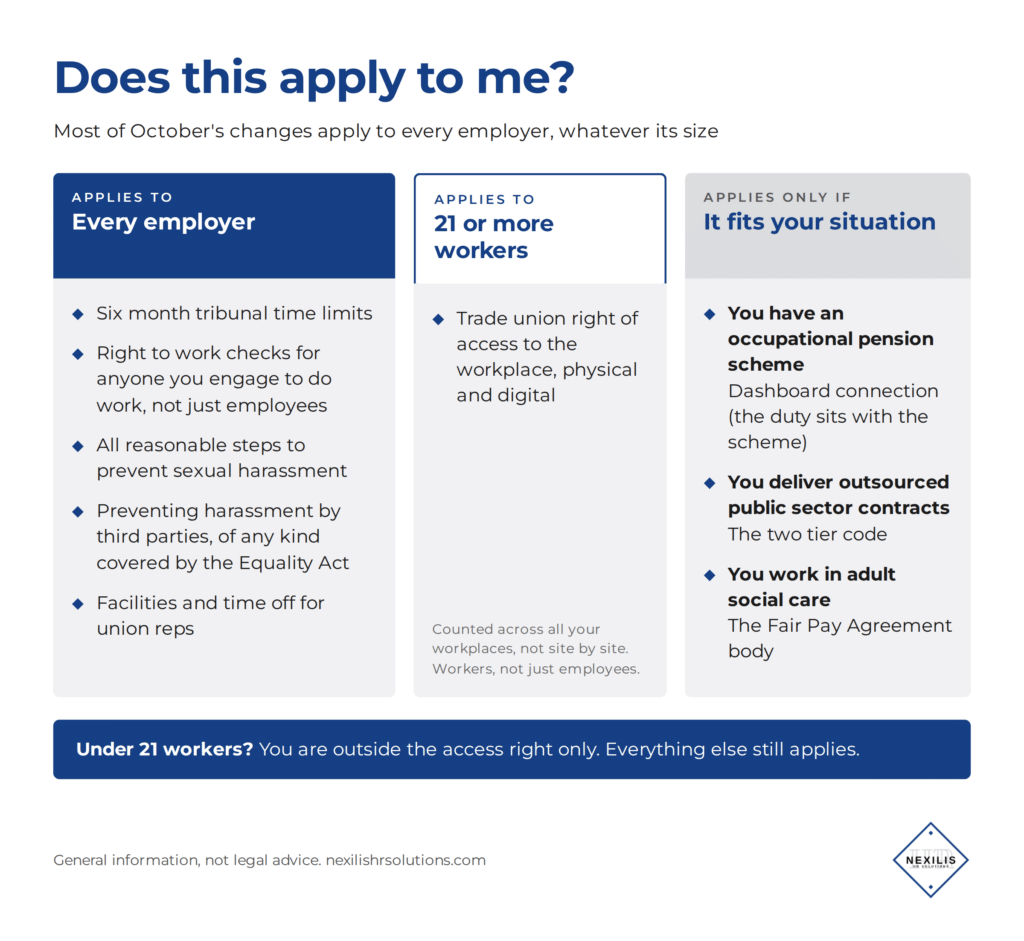
Here’s the short answer. Most of them apply to every employer, whatever the size. Only one has a headcount threshold. And one you may have read about isn’t happening in October at all.
Right to work checks: not just for your payroll any more (1 October)
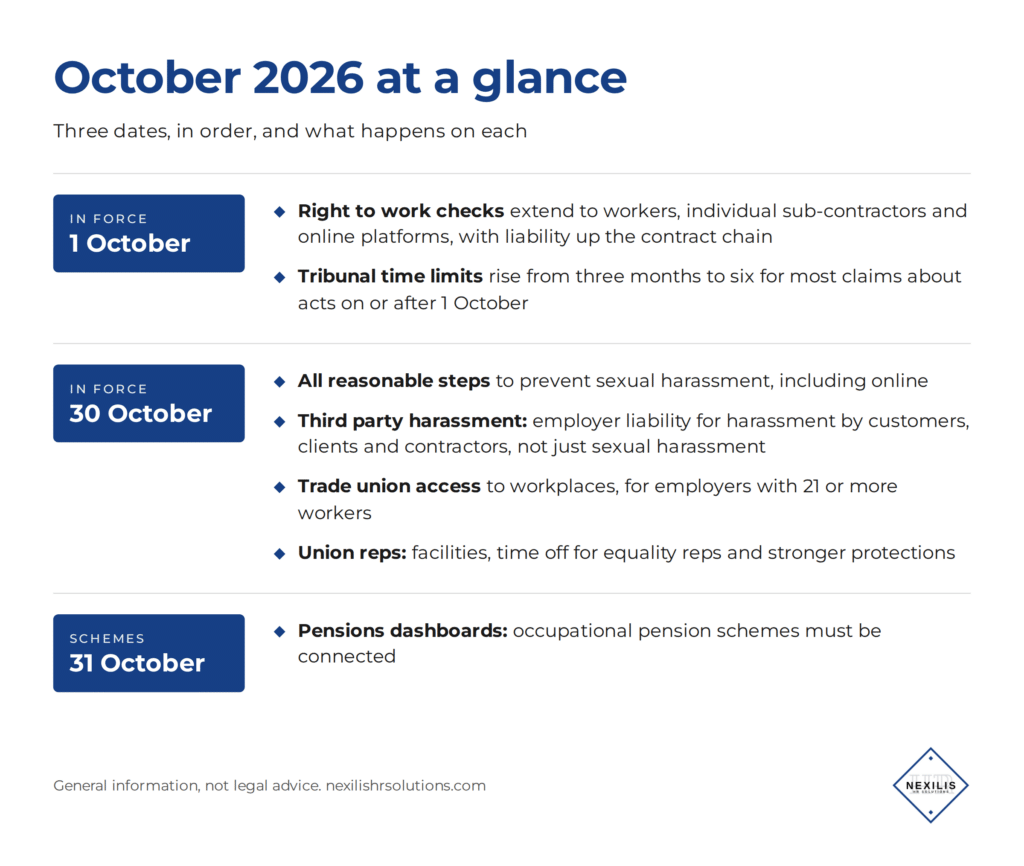
The rules on preventing illegal working now reach beyond employees to workers, individual sub-contractors and online platforms that match individuals with customers. Liability can also run up a chain of contracts, so you could be responsible for someone you never contracted with directly. Civil penalties go up to £45,000 per worker for a first breach, and £60,000 for repeat breaches.
Back to Monday morning. If a contractor sends a substitute, that person needs to have been checked before they start. A check carried out afterwards doesn’t cover the time before it. A line in your supplier’s contract saying they do the checks won’t be enough on its own either. Where you don’t engage someone directly, the Home Office’s code of practice looks for three things: written terms, control over substitutes, and a way of confirming that the person doing the work is the person who was checked.
What to do now: list everyone who does work for you but isn’t on your payroll. Casual and bank staff, sessional workers, freelancers, agency and contractor staff. That list is your to-do list.
Tribunal time limits double (1 October)
For most claims about something that happens on or after 1 October, people will have six months to bring a claim instead of three. Acas early conciliation still pauses the clock, so in practice the window can be longer.
This isn’t a reason to worry. It’s a reason to write things down. Decisions recorded at the time, with the reasons behind them, are still your best protection. It’s also worth checking how long you keep records, so you’re not deleting notes on a matter someone can still raise.
Harassment: prevention is now the test (30 October)
The duty to prevent sexual harassment moves from taking reasonable steps to taking all reasonable steps. Online harassment is in scope, so group chats, messaging apps and social media all count. Employers will also be liable for harassment of their people by third parties, such as customers, clients, service users, contractors and members of the public, where they haven’t taken all reasonable steps to prevent it. That part isn’t limited to sexual harassment. It covers harassment related to any protected characteristic, including race, disability, religion or belief, age and sexual orientation.
A policy sitting in a drawer won’t get you there. What’s reasonable depends on your size and the work you do, but the direction is clear. Think about where the risk is before anything happens. Give people more than one way to report a concern. Train across the whole organisation, not just the team where something went wrong last time. If your people work with the public, the third party duty is the one to think hardest about. Regulations setting out which steps count as reasonable aren’t expected until 2027, so don’t wait for them.
What to do now: a short risk assessment. Where do your people come into contact with the public, clients or contractors, what could go wrong there, and what will you do about it? Write it down and date it.
Trade union access: the only one with a size threshold (30 October)
Unions will be able to request access to workplaces, both physically and digitally, to meet and recruit workers. This applies to employers with 21 or more workers, counted across all your workplaces rather than site by site, and counting workers rather than just employees.
If you’re over the threshold, decide now who will handle an access request, and make sure managers know to pass one on the same day it arrives. You’ll have 15 working days to respond. If you’re under it, you’re outside the access right only. Everything else in this article still applies to you.
Pensions dashboards (31 October)
Occupational pension schemes must be connected to the pensions dashboards service by 31 October. The duty sits with the scheme, not with you, but once dashboards are live your staff may start spotting errors in their pension records. Keep the data you send your provider accurate, and point pension questions to your provider rather than answering them yourself.
Also on the radar
- Sector specific changes: new rules for outsourced public sector contracts and for pay in adult social care are also on the way. If either could affect you, including how they apply in Wales, talk to us before acting.
- Trade union statement: you may have read that every employer must give workers a written statement of their right to join a trade union before 30 October. That isn’t part of the October changes. The Government has consulted on what the statement should say and how often existing workers should get it, and the start date is still to be confirmed. There’s nothing to send by 30 October. We’ll let you know when there is.
- NDAs: restrictions on using non-disclosure agreements to stop people speaking about harassment and discrimination are now expected in 2027, not this October.
Your October to-do list
- Before 1 October: make sure no one starts work until their right to work check is done, and start your list of people who work for you but aren’t on payroll.
- Before 30 October: if you have 21 or more workers, decide who will handle a trade union access request, and make sure managers and front desk staff know to pass one on the same day.
- Before 30 October: complete your harassment risk assessment, share your reporting routes, and put training in the diary.
- From now on: record decisions when you make them, and review how long you keep records.
Want this off your plate?
If you’re a Nexilis client, we’ll be in touch about the changes and what we need from you. If you’re not, and you’d like a hand working through them, we’re happy to have a no-pressure chat about where you stand.
Email enquiries@nexilishrsolutions.com or call 03301 748521.
This article is a general summary of changes taking effect in October 2026, correct at the date of publication. It isn’t legal advice for your specific circumstances.