

In today’s unpredictable economic climate, the ability to adapt quickly is no longer a “nice to have” for small and medium-sized enterprises, it’s a competitive necessity. From changing employment legislation and talent shortages to evolving employee expectations, SMEs are operating in a constant state of change. This is where agile HR strategies come into play.
Agile HR is not about chasing trends or adding complexity. At its core, it’s about designing people processes that are flexible, responsive, and closely aligned with real business needs. For SMEs, this approach enables faster decision-making, stronger engagement, and a workplace culture that can evolve as the business grows.
At Nexilis HR, we see agile HR as a practical mindset. One that helps organisations stay human, resilient, and ready for whatever comes next.
What Agile HR Really Means for SMEs
Traditional HR models often rely on rigid policies, annual cycles, and slow approval processes. While this structure may suit large corporates, it can quickly become a barrier in smaller organisations where speed, clarity, and adaptability are essential.
Agile HR offers a smarter alternative.
Rather than operating as a compliance-heavy function, HR becomes a responsive partner to the business. This means:
- Shorter planning cycles
- Frequent, meaningful feedback
- Policies that evolve alongside the organisation
- A stronger focus on outcomes rather than process
For SMEs, agile HR removes unnecessary complexity and ensures people practices grow at the same pace as the business, without adding layers that slow teams down.
Why Agile HR Matters More Than Ever in 2026
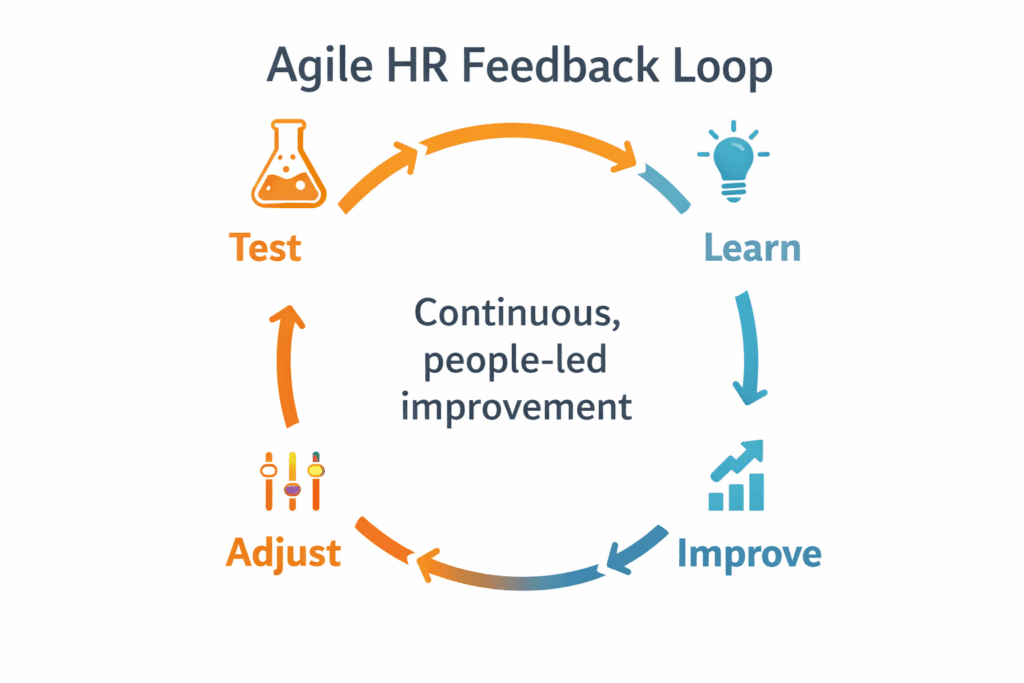
Agility in HR isn’t about constant reinvention. It’s about building feedback loops into your people strategy so you can test ideas, learn quickly, and improve continuously.
Involving employees in shaping how work is done, from onboarding and performance conversations to flexible working arrangements, leads to better engagement and more sustainable solutions. When people feel trusted and heard, they’re far more likely to support change rather than resist it.
Research consistently supports this approach. CIPD highlights that organisations adopting agile people strategies are better equipped to respond to change, while McKinsey & Company reports that agile organisations are significantly more likely to outperform competitors financially and operationally.
For SMEs navigating growth, pressure, or uncertainty, agile HR helps focus on what really matters: getting the best out of your people without burning them out.
The Role of Leadership in Agile HR

Agile HR can’t succeed without the right leadership mindset.
Business owners and senior leaders play a critical role in setting the tone for agility across the organisation. This includes how quickly decisions are made, how feedback is welcomed, and how open the business is to change.
Agile leadership isn’t about having all the answers. It’s about:
- Encouraging experimentation
- Creating psychological safety
- Removing barriers to progress
- Being transparent about priorities and direction
When leaders model flexibility and continuous learning, teams naturally follow. Even in businesses with fewer than 20 employees, leadership behaviour has a direct impact on whether agile ways of working truly take hold.
How Nexilis HR Supports Agile People Strategies
Adopting agile HR doesn’t mean starting from scratch and it doesn’t mean doing it alone.
Working with an independent HR partner like Nexilis HR gives SMEs access to specialist expertise without the cost or complexity of building in-house capacity. Our role is to help businesses make focused, realistic changes that deliver measurable value.
We support organisations by:
- Reviewing existing HR processes to identify where agility will have the greatest impact
- Designing people strategies that balance compliance with flexibility
- Facilitating employee feedback sessions and workshops
- Supporting leaders in adopting more responsive, people-first approaches
- Introducing simple tools to track progress and adapt quickly
Because we work across multiple sectors, we bring practical insight grounded in what genuinely works for growing SMEs.
Seven Practical Ways to Introduce Agile HR in Your Business
- Make Performance Conversations Ongoing
Replace annual appraisals with regular check-ins that focus on progress, priorities, and development. - Pilot Changes Before Rolling Them Out
Trial new ideas such as flexible hours or team structures with one group before committing business-wide. - Involve Employees Early
Ask for input when changing policies or processes. Early feedback reduces resistance and improves outcomes. - Focus on What Adds Real Value
Remove processes that don’t support business goals or employee experience. - Set Short-Term People Objectives
Use quarterly goals that align with business priorities and review them regularly. - Make Progress Visible
Simple tools like shared dashboards or weekly updates help teams stay aligned and involved. - Give Teams More Autonomy
Empower teams to trial small changes in how they work, it builds accountability and innovation.
Agile HR: A Mindset for Sustainable Growth
Agile HR isn’t a passing trend. It’s a mindset shift that enables SMEs to remain responsive, people-focused, and competitive in a fast-changing world.
By making smarter decisions faster and by trusting your people to play an active role in shaping how work gets done, you create a stronger, more resilient organisation.
With the right support, tools, and leadership approach, agile HR can help your business not just keep pace with change, but thrive because of it.
Frequently Asked Questions: Agile HR for SMEs
What is Agile HR in simple terms?
Agile HR is a way of managing people that prioritises flexibility, collaboration, and continuous improvement. Instead of relying on rigid policies and annual cycles, agile HR focuses on regular feedback, short-term goals, and adapting quickly to what the business and employees need right now.
Is Agile HR suitable for small businesses, or just larger organisations?
Agile HR is particularly well suited to SMEs. Smaller teams benefit most from faster decision-making, simpler processes, and closer collaboration. Agile HR helps SMEs stay responsive without adding unnecessary structure or administrative burden.
Do we need to change all our HR processes to become agile?
No. Agile HR is not about replacing everything at once. Most organisations start with small changes — such as more regular performance conversations or trialling flexible working arrangements — and build momentum over time. Incremental improvements often deliver better results than large-scale overhauls.
How does Agile HR support employee engagement and retention?
By involving employees in decisions that affect how they work, agile HR builds trust and ownership. Regular feedback, clear priorities, and flexibility help employees feel valued and supported, which in turn strengthens engagement and reduces turnover.
Will Agile HR still keep us compliant with employment law?
Yes. Agile HR does not replace compliance — it enhances how compliance is delivered. Policies and procedures still meet legal requirements, but they are designed to be practical, clear, and adaptable. Many organisations use agile principles to keep documentation up to date as legislation changes, rather than reviewing it once a year.
What role do leaders play in making Agile HR successful?
Leadership is critical. Agile HR works best when leaders role-model openness, adaptability, and trust. This includes welcoming feedback, supporting experimentation, and being clear about business priorities. When leaders embrace agility, it quickly becomes part of the wider culture.
How can an external HR partner help?
An external HR partner brings experience from working with multiple organisations and sectors. They can help identify where agility will make the biggest impact, support leaders through change, and introduce practical tools without adding cost or complexity. This allows SMEs to move faster with confidence.
How long does it take to see results?
Many businesses start to see improvements in communication, engagement, and decision-making within a few months. Because agile HR focuses on short feedback loops and regular review, progress is often visible quickly — especially compared to traditional annual HR cycles.